
Transformation Communication
Five Tools for Effective Leadership Communication During Constant Changes
by Lene Kobbernagel
"Starting Monday, we're all going back to the office five days a week."
That's the message Anne — a senior leader at a US-owned medical device company — has to deliver. She doesn't personally believe it's the best solution. It's the third unpopular change in just a few months, and Anne knows the timing is difficult. The company is in the middle of a transformation: sweeping restructuring designed to drive better performance in a changed market.
The transformation has handed Anne a difficult communication task. How should she communicate a stream of unpopular changes in a way that keeps people engaged? How does she stand behind something she doesn't necessarily endorse herself? How does she involve her leaders and employees constructively — without fueling frustration?
The answers to those questions are also the answers to how a company succeeds.
“Transformation is triggered by strategy — but it only succeeds through people.”
According to a McKinsey report, 70% of a transformation's success depends on leaders' ability to engage people. Effective leadership communication at every level is decisive. The cost of getting it wrong is steep:
· Large projects fail at seven times the rate when communication is not in place.
· 60% of change initiatives fail when communication falls short.
· 63% of employees cite poor communication as the reason they left a company.
As a communication trainer for leaders at all levels, I find that leaders genuinely want to communicate well — but lack the tools for how to communicate effectively when the stream of change is ongoing. What they used to say no longer works. The traditional "Sense of Urgency" narrative — "if we only understand the why" — no longer motivates. People are tired of threat scenarios and burning platforms.
“The why alone no longer motivates. Leaders need new tools.”
To find answers for Anne, and the many leaders like her, I interviewed leaders from People & Organisation departments and leaders who have personally driven transformations at VELUX, Microsoft, Nykredit Spar Nord, TDC Brands, Demant, and The Adecco Group. Those findings are gathered in my report Transformation Communication. Here are five key insights.
Five Communication Tools
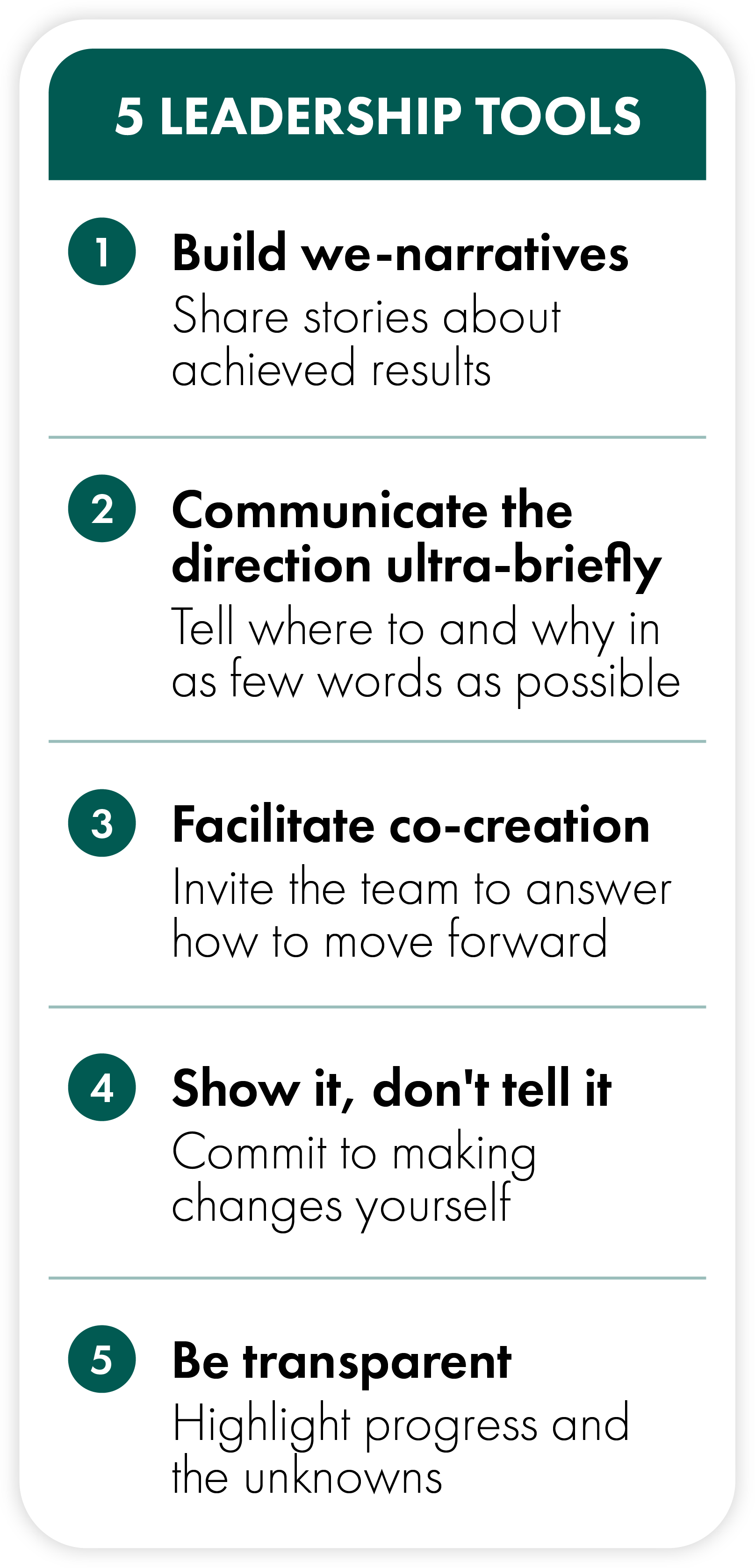
1. Build we-narratives
Leaders must turn up the volume on a "we-narrative." A we-narrative is a story about a team's achieved results and an understanding of how those results create momentum. The leader must articulate the team's relevance to the future of the business, so the team grasps its key role in driving the transformation forward.
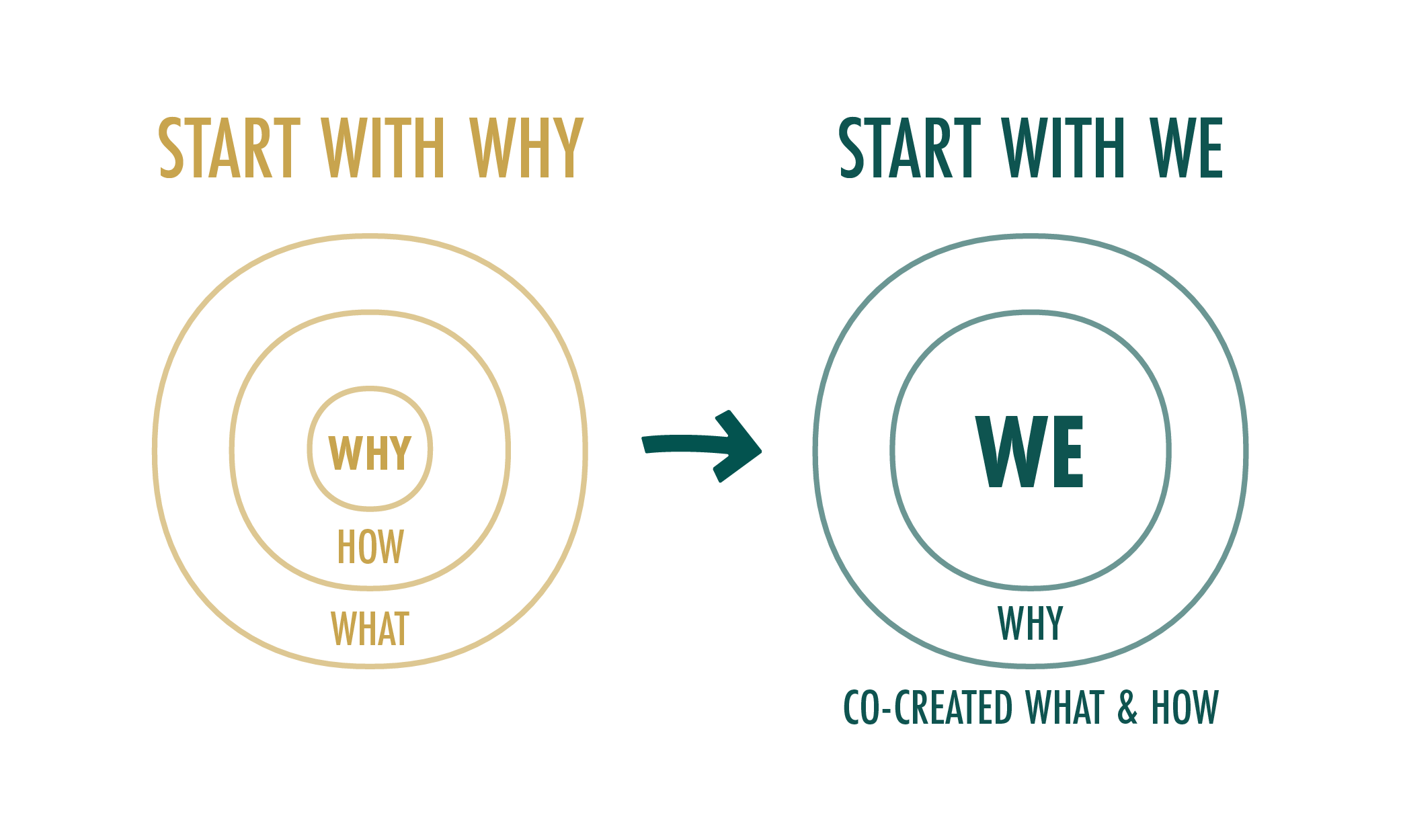
For years, leaders have been taught to prioritise a strong why-story in times of change. The why still needs to be communicated — but made very brief. In transformations, it's the we that needs to dominate leadership communication. Leaders should dial down the Sense of Urgency narratives dominated by burning platforms and threat scenarios, and instead make room for Sense of Belonging narratives — where the leader talks about the results the team has already created and the momentum that has contributed to the transformation.
““In a transformation, the only constant is that people show up to work every day. We know that. Everything else is in flux. In transformations, leaders must elevate the collective ‘we.’””
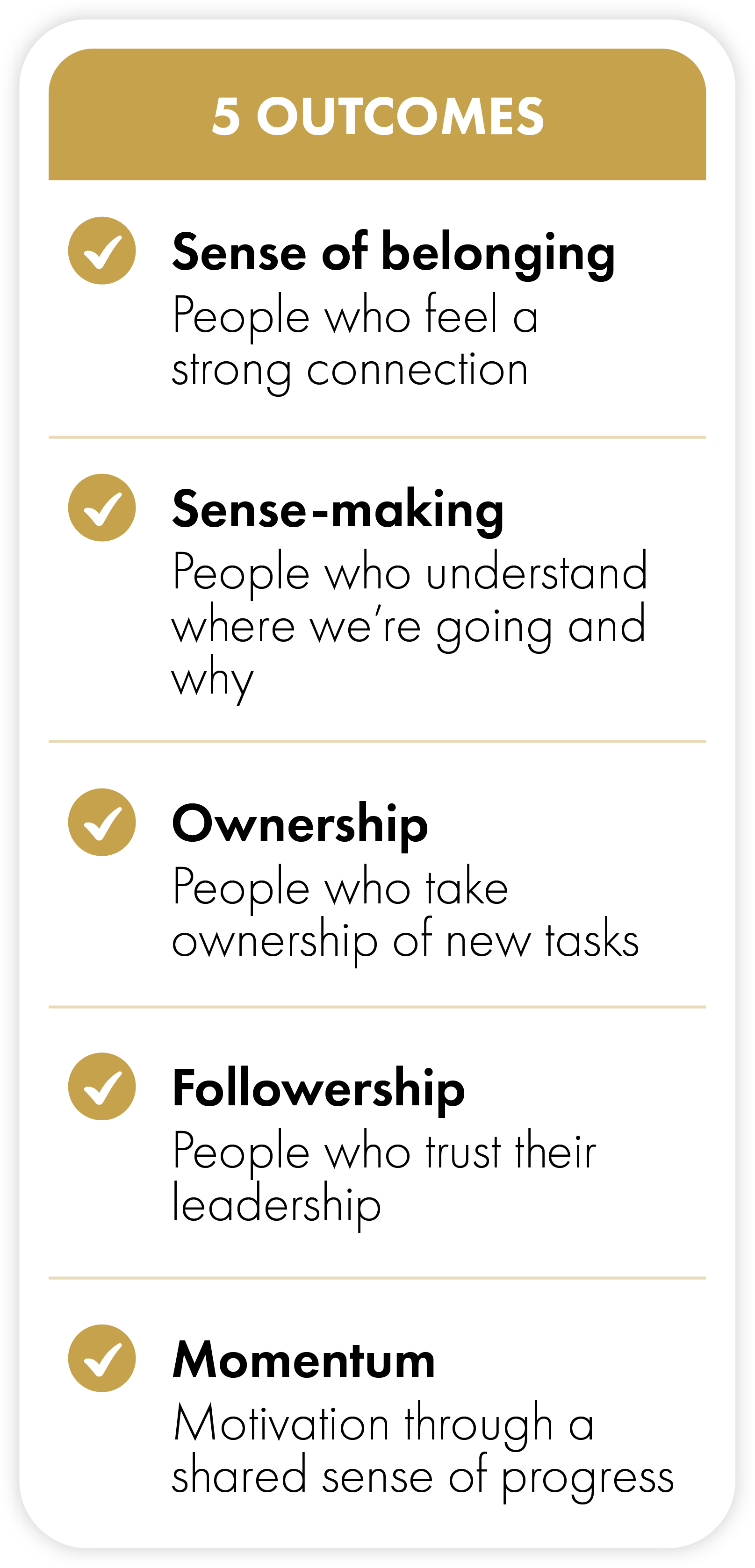
We-narratives build shared pride, a strong sense of identity, and a strong sense of belonging. That is what makes the difference between a team that steps into a transformation with drive — and one that approaches it with resignation.
2. Give crystal clear directions

"Where are we going?" Every employee must be able to answer that in their sleep — which means leaders must be able to formulate it in half a sentence. "Why is it necessary?" Leaders must also be able to formulate that in half a sentence. There must be no ambiguity about a transformation's direction and necessity among any group of employees. The ultra-brief formulations create clarity. And clarity creates calm.
An ultra-short why is repeatable across units, management layers, and different arenas. Mattias Krogh-Møller from VELUX puts it precisely: "Downplay the why. Half a sentence is enough."
It can be as short as two words — as at VELUX, where the transformation is called: Performance Unlocks. Senior leadership must refrain from translating what the direction means further down the organisation, and never explain how it should be done.
““Downplay the why. Half a sentence is enough.””
The only people who can make the direction meaningful are those working with the tasks every day. As HR Business Partner Rikke Gundborg says:
"The middle manager is the defining player in a transformation's actual rollout. Only the individual leader who is close to the team executing the tasks can actually create a meaningful 'why' together with their team. The middle manager must have the authority to define the way we understand it, and the way we work."
3. Facilitate co-creation
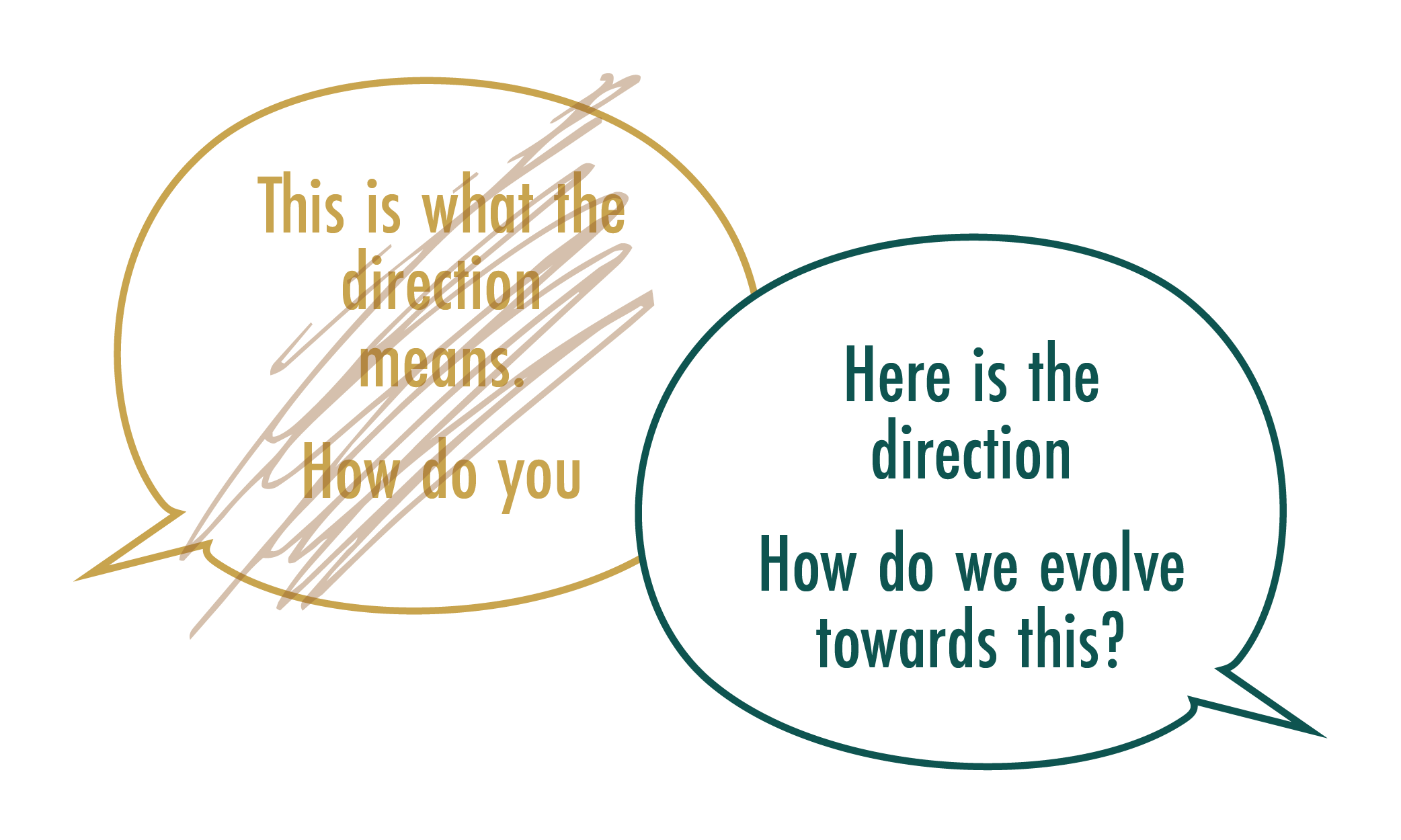
‘Leaders must be skilled at facilitating co-creative development dialogues. Co-creation means leaders facilitate a dialogue about how the team develops relevance in relation to the centrally announced why. The leader must ask questions — not provide answers. The questions should trigger a generative process and might sound like: "Which tasks are we already doing that create momentum? Which tasks can we remove? Which tasks and "The most credible channel for how people are doing along the way is colleague-to-colleague."
— Trine Ahrenkiel, HR, Communications and Marketing Director, Nykredit Spar Nord
Stories about how things are going — small victories, frustrations, fears, hopes, and joys — should be invited and held, but NOT steered by a leader. This can happen in internal corporate communities, for example, where people on an internal social platform are invited to share experiences along the way.
4. Show it, don't tell it
When employees can feel that leaders themselves are acting differently, it motivates more than a thousand words. Leaders must therefore be a transformational role model. They must commit to changing their own behaviour. Mattias Krogh-Møller from VELUX:

"What behavioural change must I, as a leader, demonstrate? That question all leaders must ask themselves, and it must start at the top. ."
— Mattias Krogh-Møller, VELUX
Leaders must demonstrate through actions, commitments, and visible changes in the framework that they are in the process of developing the organisation in the right direction. They must develop initiatives where employees can genuinely see and feel the transformation's purpose in practice.
5. Report how far you've come — and what you don't know
Leaders must create a sense of momentum, because progression motivates. Knowing we're on our way creates calm and security. That's why leaders must continuously articulate what the team has achieved and how far the business has come.'
“Tell what you know, tell what you don’t know, and be honest about the difference.”
Leaders must dare to be transparent about everything they don't know. People can handle a great deal of uncertainty — what they cannot handle is ambiguity, and the feeling that information is being kept from them. That's why naming the difference between what is certain and what is uncertain builds trust. Elena Costantini, former Transformational COO at The Adecco Group explains it precisely: “Tell what you know, tell what you don't know, and be honest about the difference. That is what builds the trust that holds an organisation together as it moves through the difficult periods."
A Leader Who Succeeds
Transformations have no endpoint and no closing date — and so they must be communicated as momentum in a clear direction.
That requires leaders who understand that momentum matters more than management, that achieved results outweigh unachieved goals, and leaders who dare to relinquish control over how the team executes — in favour of investing in making team spirit real.
Back to Anne.
How should she communicate her message about five days a week in the office to her team? That answer you can find in the full report.
Let’s explore training options together
Please send me an email, and let’s meet to discuss how I can support your leaders in communicating effectively during your transformation.
lene@lenekobbernagel.dk


